
emergent wayfinding for a flourishing planet
our new byline, a new ritual, and some lab updates
To describe Collaborative Earth in just a phrase presents an interesting challenge, because our organization doesn’t fit familiar models. We work across disparate disciplines, our structure isn’t conventional, and we span the continuum from research into on-the-ground work. Yet sometimes we need to sketch or at least evoke in just a few words what it is we do and how we do it. We’ve been working on this subtle challenge of effective conjuring, and the new byline that has risen to the top is the one you’ve just encountered in the header to this newsletter: emergent wayfinding for a flourishing planet.
In its first year of existence, Collaborative Earth piloted and improved a process for bringing people across disciplinary and cultural boundaries, forming effective teams to chart novel pathways to regeneration. These teams, which we call Collaborative Earth Labs, are emergent in the sense that no one person masterminds their formation; they arise through a process in which a prospective lab leader identifies a question or need that stands in the way of regeneration, and individuals in CE’s diverse network step forward to offer the insights and skills required to find a new path forward. To describe the work that unfolds in CE Labs, we like the term wayfinding for its association with certain cultures’ sophisticated practices of navigation of land- and seascapes, and for its connotation of integrating diverse categories of information to discover orientation and direction. In most CE Labs, deeply rooted local knowledge is an essential element in the co-creative process, which may also call on various scientific disciplines and leading-edge technologies.
All of this is best understood through specific examples, and you’ll find updates on our CE Labs below.
a new ritual
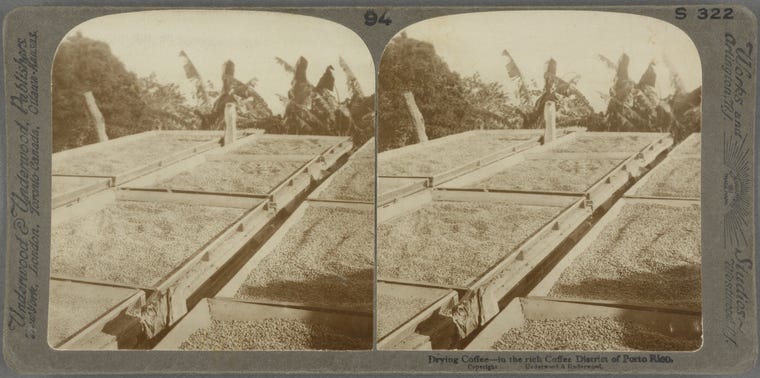
Image: Drying Coffee, NYPL Digital Collections Project.
One drawback of our distributed work ways is that there aren’t accidental opportunities to chat, no found half-hour here or there to grab a coffee. And while the CE Labs focus on different kinds of problems in different parts of the world, the individuals involved in that work do share a great deal—an urgent desire to help regenerate our places and planet, an interest in working across disciplines to chart new paths.
All of this seems to suggest we ought to make a little time to update one another on what’s happening in our respective corners of CE and to connect with members of this network who don’t happen to be involved in our particular line of activity. So we’re launching our new ritual - the time-zone-appropriate beverage hour:
Prepare your tea, beer, or whatever suits your local hour and current mood, and join us for forty-five minutes of conversation about what’s happening in Collaborative Earth. For those new to the org, we’ll take about five minutes to introduce CE and talk about ways to get involved. Then we’ll hear an update from one of our current Lab Leaders—this month, Anthony Acciavatti, from Ganges Lab. And finally we’ll make some room to enjoy meeting the diverse and talented individuals coming together to regenerate our places and our planet.
lab updates
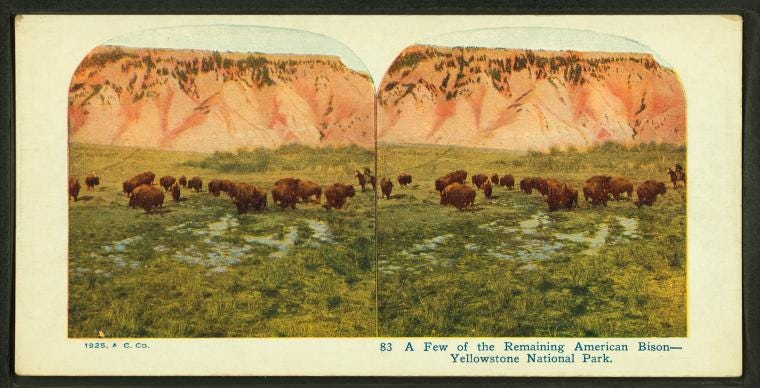
Image: A Few of the Remaining American Bison—Yellowstone National Park, NYPL Digital Collections Project.
Bison Lab has new work unfolding in two different areas. In the Wind River Range, we are working closely with the Eastern Shoshone Buffalo Program to design and develop experimental plots that will be used for two different but interrelated purposes. First, they will be used to assess the ecological effects of rewilded bison on ecological variables such as soil carbon, biodiversity, and water retention. Second, they will serve as one component in the Buffalo Program’s important educational offerings, covering the vital cultural role of the species, opportunities for tribal food security, as well as collection of ecological data and how it may open future opportunities for expansion of the rewilding program.
In Oklahoma, in partnership with the Cheyenne-Arapaho tribes, we are moving forward with USDA-funded work to measure the effects of bison on grassland ecology. While there is suggestive evidence in the scientific literature for potential climate-related benefits of certain practices in bison management, this field of research is nascent. In this project, we will be working with the tribes, as well as our collaborators at Mad Agriculture, to implement regenerative bison grazing practices on thousands of acres of tribal land. In the process, we will be rigorously measuring the climate-related effects of this transition in land use and management. More specifically, we will make direct measurements of carbon dioxide and methane emissions using eddy covariance flux towers, while also conducting intensive soil sampling and measurement of changes in soil biogeochemistry over a period of five years. We’d also like to announce that this project is seeking a soil scientist. A description of the opportunity is here.
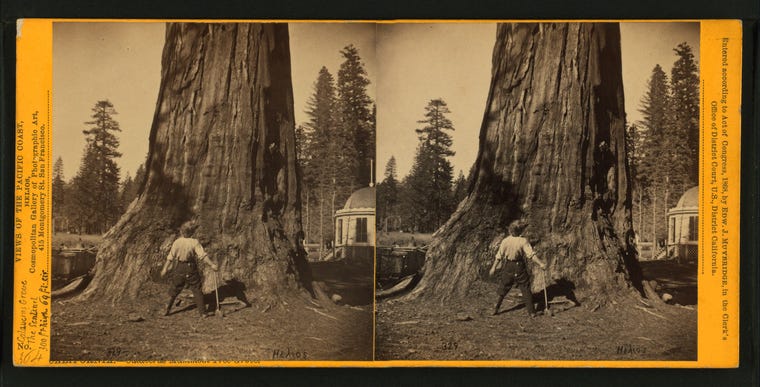
Image: The Sentinel, NYPL Digital Collections Project.
The Assisted Forest Regeneration Lab has successfully concluded its work, having located and annotated hundreds of useful resources from thousands of gray literature documents. Well done to all of the Lab members! This work will now go to our academic partners at ETH Zürich, who will incorporate the sources we found into their larger database, which will involve some data cleaning and follow-up outreach on a case-by-case basis. While the academic analysis is ongoing, the AFR Lab is now taking a month-long break to consider other ways to support the goal of global reforestation; we are thinking about more non-traditional and broadly accessible outcomes of the project, including mapping. If this draws your attention, please feel free to reach out to us at team@collaborative.earth.
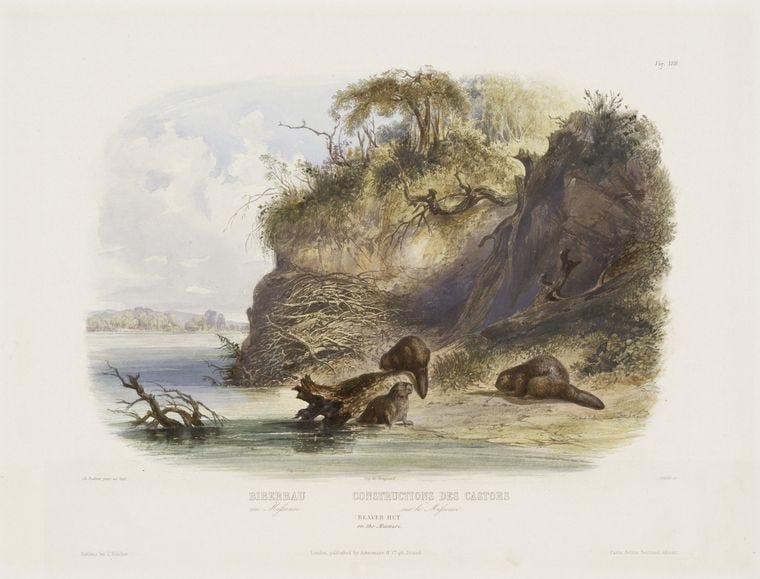
Image: Beaver Hut on the Missouri, NYPL Digital Collections Project.
The Beaver Lab is working to understand what ecological effects of beaver dams can be perceived through remote sensing, in order to make studying and managing beavers easier. To this end, they have collected and generated datasets identifying thousands of beaver dam locations across the US. Through collaborations with external researchers, as well as further curation and annotation work in-house, they are expanding their data set of dams even further. Meanwhile, developing their data analysis pipeline, they are gathering large amounts of geospatial data at their dam locations as well as comparable controls, which will allow them to analyze differences. Finally, all of this work is funneling into an important ultimate goal of the lab, a machine learning model that can help predict the impacts of a beaver dam at a given location along a waterway.
Images: For this newsletter’s graphics, we have selected imagery from the New York Public Library’s Digital Collections project, a wonderful trove of material in the public domain.